Let's have a chat and discuss your specific needs
Conter provides smart tailored digital transformation solutions to its clients.



The enterprise software landscape is shifting — and fast. AI is no longer a feature bolted onto existing products. It is reshaping how software is built, delivered, and consumed. Across the industry, a serious debate is underway about what this means for the platforms organisations depend on. Bain & Company recently examined whether agentic AI will disrupt SaaS, while TechCrunch and others have been tracking the pressure on traditional per-seat subscription models as AI agents begin to automate entire workflows.
This is not a theoretical discussion. The economics of enterprise software are being challenged in ways we have not seen since the shift from on-premise to cloud. And in the middle of it, ServiceNow just made one of the most significant strategic moves in the platform’s history.
On April 9, 2026, ServiceNow announced in a press release that its entire product portfolio will be AI-enabled. Not as an add-on. Not as a premium tier. Every product now includes AI, data connectivity, workflow execution, security, and governance built in.
Three elements stand out.
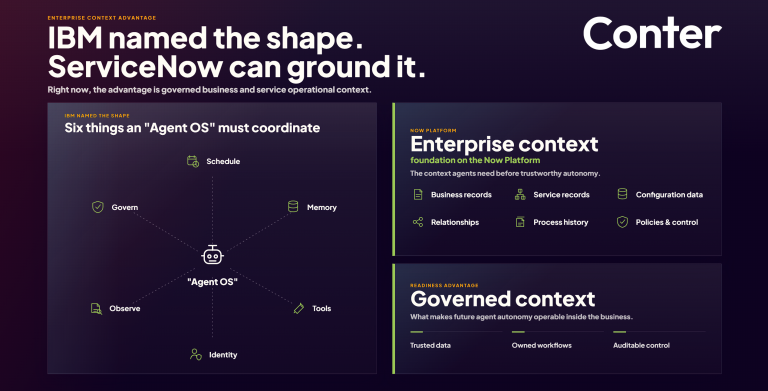
Context Engine is a new enterprise context layer that connects relationships, policies, and decision history behind every AI agent decision. Built on ServiceNow’s Service Graph, Knowledge Graph, and data inventory, it gives AI the ability to understand which asset is tied to a regulated process, which approval chain applies to a given cost threshold, and which vendor history should inform how a request is handled. This is not generic intelligence — it is enterprise-specific context, grounded in real operational data.
Build Agent skills open the platform to developers working in any environment — Claude Code, Cursor, Windsurf, and others — allowing them to build and deploy directly to ServiceNow. Instead of requiring developers to work exclusively within ServiceNow’s own tools, the platform meets builders where they are.
ESM Foundation brings enterprise service management to midsize organisations, bundling IT, HR, legal, finance, procurement, and workplace services onto the AI Platform with a promise of going live in weeks, not months.
Taken together, these moves signal something bigger than a product update. ServiceNow is repositioning — from a platform you pay for because of its features, to a platform you pay for because your enterprise context lives there and AI needs it to function.
This repositioning is the most interesting part of the announcement, and it reflects a pattern we see across the industry.
As AI capabilities become widely accessible — and they are, rapidly — the differentiator is no longer what the software can do. It is what the software knows. Context Engine is built on CSDM data structures: the Service Graph, the Knowledge Graph, the configuration and asset data that maps how an organisation actually operates. That is not something you spin up overnight. It is the result of years of data governance, process design, and architectural discipline.
In our work with enterprises, we see this first-hand. The organisations that get the most value from their platforms are not the ones with the most features enabled. They are the ones with clean data models, well-governed lifecycles, and architecture that connects the dots across domains. CSDM has always been the backbone of that coherence. What is changing now is that AI is making it visible — and indispensable.
When an AI agent needs to decide whether to auto-approve a change request or escalate it, it does not just need language understanding. It needs to know the business context: the asset classification, the regulatory requirements, the approval history. That context comes from governed data. Without it, the AI is guessing — confidently, at scale.
The promise of AI-native platforms is real. But so is the risk of moving fast without structure.
As AI-assisted development accelerates — and we are seeing this across the industry, from citizen developers describing workflows in plain language to teams building production applications in days — the volume of what organisations can create is growing exponentially. That is genuinely exciting. It is also a governance challenge.
Every new application, every AI agent, every automated workflow needs to connect to the rest of the enterprise. It needs to follow approval chains, respect data boundaries, and operate within the organisation’s compliance framework. The platforms that enable this — ServiceNow among them — provide the governance backbone. But the platform alone is not enough. The foundation has to be in place: the data model has to be clean, the processes have to be defined, the lifecycle has to be governed.
This is not new work. Organisations that have invested in enterprise architecture, in CSDM adoption, in structured service management — they are the ones best positioned to capture the value of AI-native platforms. The foundation work that may have felt slow or unglamorous is now the asset that makes everything else possible.
The technology is moving fast, and there is every reason to be optimistic. ServiceNow’s direction is sound — embedding intelligence into the platform, opening it to builders, grounding AI in enterprise context. These are the right moves for a landscape that demands more from its platforms than features and dashboards.
But the organisations that will get the most from this shift are not the ones that move fastest. They are the ones that move with structure. Clean data. Governed processes. Architecture that holds together as the pace accelerates.
That is where the real work is. And it is far from done.
By Kristina Petrić and Michel Conter

At Conter.biz, we specialise in enterprise architecture, service management, and CSDM governance — helping organisations build the foundations that make AI-native platforms deliver real value.